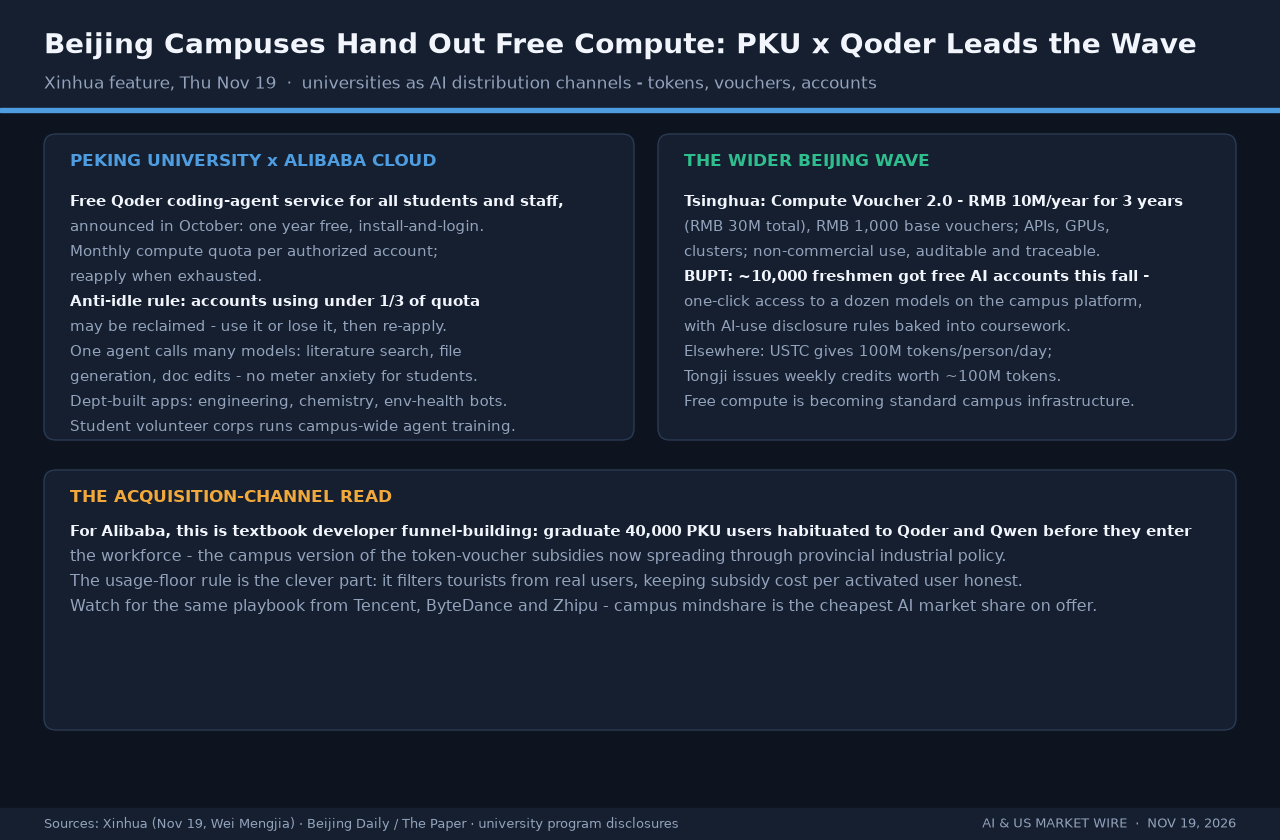
A Xinhua feature on Thursday, November 19 documented Beijing universities distributing free AI compute as standard campus infrastructure: Peking University’s partnership with Alibaba Cloud (announced October) gives every student and staff member a year of free Qoder coding-agent service with monthly quotas and reapplication — plus an anti-idle rule reclaiming accounts that use under a third of their allowance — while Tsinghua’s Compute Voucher 2.0 commits RMB 30 million over three years (RMB 10 million annually, RMB 1,000 base vouchers for APIs, GPUs and clusters, non-commercial use only, auditable), BUPT opened free AI accounts for ~10,000 freshmen this fall on its “compute for everyone” platform with AI-disclosure rules baked into coursework, and beyond Beijing, USTC grants 100 million tokens per person daily and Tongji issues weekly credits worth ~100 million tokens. The acquisition-channel read is the interesting part: for Alibaba this is textbook developer funnel-building — habituating tens of thousands of PKU users to Qoder and Qwen before they enter the workforce, the campus twin of the token-voucher subsidies spreading through provincial industrial policy — and the usage-floor rule cleverly filters tourists from real users to keep subsidy cost per activated user honest; expect the same playbook from Tencent, ByteDance and Zhipu, because campus mindshare is the cheapest AI market share on offer.